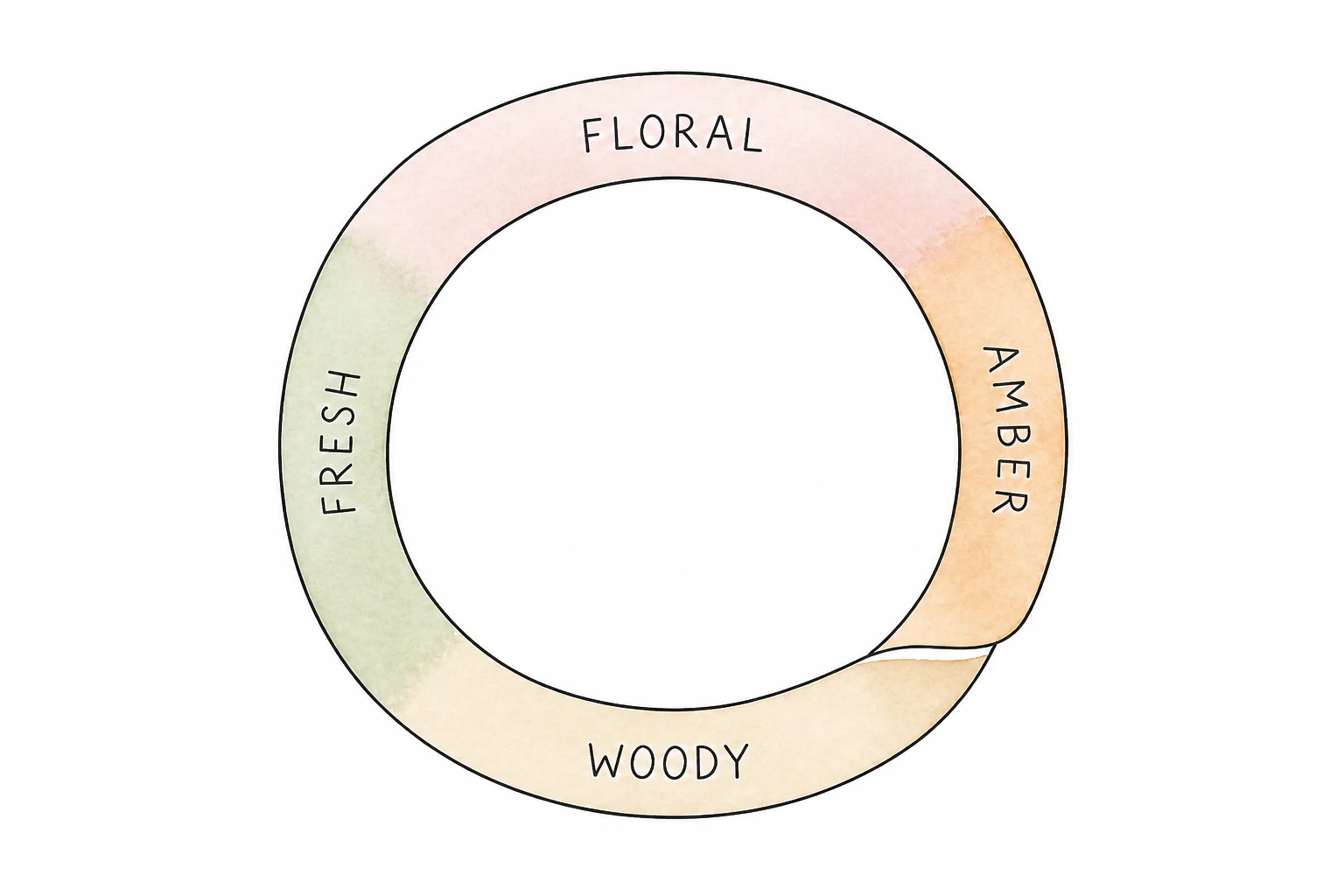
Fragrance families group perfumes by shared character. The modern map has four main families: floral, amber, woody, and fresh, arranged on a wheel where each shades into its neighbours. Families turn “I like this” into a direction you can search; the borders between them are where most modern perfumes actually live.Scenday uses the four families as a compass, not a cage.
Card 02 · one of 11 in the guides catalogue
What fragrance families are
A fragrance family is a territory of scents that share a recognisable character, the way rose, peony, and jasmine perfumes all read as floral even when they smell nothing alike in detail. Families exist because ten thousand perfumes are unbrowsable but four directions are not. They are the coarse map of scent space: once you can name your territory, every shelf, review, and recommendation gets legible.
If notes are the vocabulary of fragrance, families are the grammar, the structure that organises individual words into sentences you can navigate. A family tells you less than a notes list but tells it faster, which is exactly what a map is for.
The wheel: watch the map assemble
The standard map is a wheel, and its genius is the shape: a circle has no far corners. Every family touches two neighbours, transitions are gradual, and relatedness becomes geometry: close means similar. Scroll the map together:
Four territories, no far corners.
The territories: floral petals, amber warmth, woody frame, fresh air. Every perfume you will ever meet lives somewhere on this circle.
The borders: where neighbours share materials, and where most modern perfumes actually live. Adjacent means related; that is the whole trick of the wheel.
The four territories, as an atlas
Each family, read as an atlas entry: terrain, landmarks, borders, climate:
Floral
the largest territory: petals in every register
- Terrain
- From soapy-clean single roses to heady, honeyed white-flower bouquets.
- Landmarks
- rose · jasmine · peony · tuberose · orange blossom
- Borders
- fresh (green florals) · amber (florientals)
- Wear
- Daytime and spring by instinct, but the heavy end owns evenings too.
Amber
the warm quarter: formerly “oriental”
- Terrain
- Resins, vanilla, incense, and spice; velvet warmth that sits close and lasts.
- Landmarks
- vanilla · labdanum · incense · cinnamon · benzoin
- Borders
- floral (florientals) · woody (woody ambers)
- Wear
- Evenings, cold months, small rooms: warmth blooms when the air is cool.
Woody
the frame: composed, grounded, quietly confident
- Terrain
- From creamy sandalwood to smoky vetiver and dry cedar; structure more than sweetness.
- Landmarks
- cedar · sandalwood · vetiver · patchouli · oakmoss
- Borders
- amber (woody ambers) · fresh (aromatic woods)
- Wear
- The office-safe depth: year-round, and the usual home of “professional” scents.
Fresh
air and light: the territory of lift
- Terrain
- Citrus sparkle, cut-grass green, sea air, and herbal aromatics; brightness over depth.
- Landmarks
- bergamot · neroli · galbanum · mint · marine notes
- Borders
- floral (green florals) · woody (fougère country)
- Wear
- Heat, daytime, close quarters: where anything heavier would shout.
The cheat sheet
| Family | Feels like | You’ll recognise | Start here if you like |
|---|---|---|---|
| Floral | A garden at different hours | rose, jasmine, peony | fresh flowers, soap, face cream |
| Amber | Velvet warmth | vanilla, incense, spice | dessert, candlelight, winter coats |
| Woody | A composed room | cedar, sandalwood, vetiver | pencil shavings, dry gin, libraries |
| Fresh | Open windows | bergamot, green leaves, sea air | citrus peel, cut grass, cold water |
Finding the family you live in
You do not choose a family; you notice one. Look at the evidence you already have (the scents you rebuy, the candles you burn down, even the smells you pause for on the street) and place them on the wheel. Most people find their answers cluster in one territory with a lean toward one border. That cluster-plus-lean is the beginning of a scent profile, and the same pattern-reading that eventually surfaces a signature scent.
A map, not the territory
Two honest limits before the map becomes a cage. First, classifications differ: houses, retailers, and reviewers draw the lines differently, and the wheel itself has been redrawn several times, most visibly when the industry renamed the “oriental” family to amber. Second, modern perfumery lives on the borders: many of the most-loved contemporary scents are deliberate hybrids that two experts would file in two different territories. Use families the way you use any map: to choose a direction, not to decide in advance what you are allowed to find.
The interactive fragrance wheel is in development: every territory and border, and which neighbours your scents keep. Get early access and we will tell you the day it opens.
What the wheel will show →Questions people ask
What are fragrance families?
Fragrance families (also called perfume families) are groups of perfumes that share a recognisable character: floral, amber, woody, or fresh. They are the coarse map of scent space: a way to turn “I like this” into a direction you can search.
What are the four main fragrance families?
Floral (petals, from soapy-clean to honeyed), amber (warm resins, vanilla, and spice), woody (cedar, sandalwood, vetiver), and fresh (citrus, green, and aquatic notes). Most classifications, including the fragrance wheel, build on these four.
What is the fragrance wheel?
The fragrance wheel is a circular map of scent families, popularised by taxonomist Michael Edwards, in which each family shades into its neighbours. Adjacent families share materials, which is why the wheel predicts which scents feel related.
What happened to the ‘oriental’ family?
The industry has largely renamed the ‘oriental’ family to ‘amber’, a more descriptive and less loaded term for the same territory: warm resins, vanilla, incense, and spice. Older books and sites still use the old name.
Sources & further reading
- Fragrances of the World: Michael Edwards’ fragrance wheel and classification
- The Osmothèque: the international perfume conservatory, Versailles
- The Perfume Society: fragrance families and education library
- Fragrantica: the community encyclopedia of perfume groups and notes
- Kaeppler and Mueller, Chemical Senses: the review showing perception-based odour classification has never settled on one accepted system
How this lesson was made
- Written and edited by the Scenday Editorial Desk.
- Founder-reviewed on .
- 5 primary sources cited (see Sources & further reading above).
- Changes to this lesson are recorded in our Corrections & updates log.