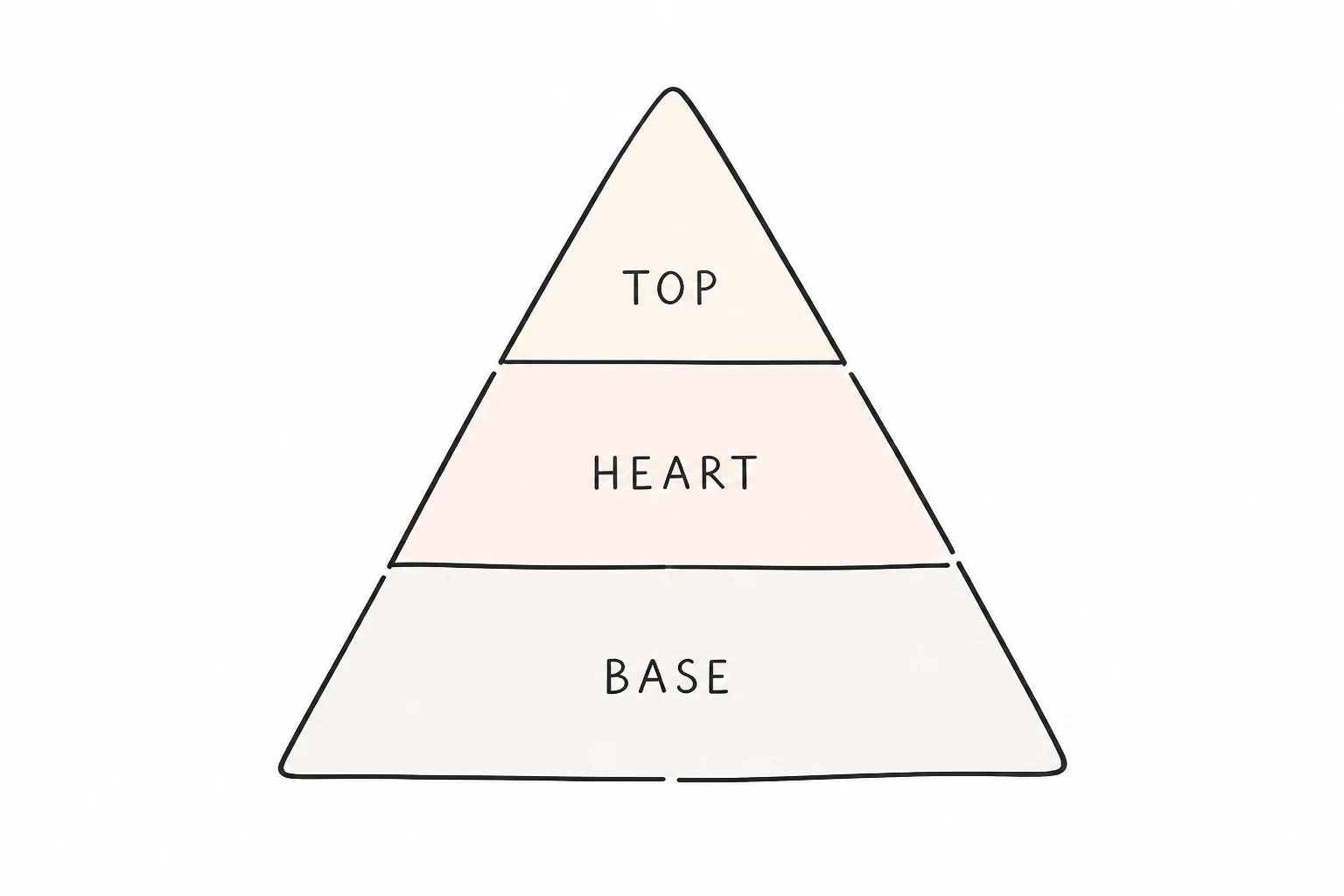
Perfume notes are the scent impressions you can smell in a fragrance, described in three layers: top notes (the first minutes), heart notes (the next few hours), and base notes (what lasts into the evening). They appear in that order because they evaporate at different speeds, which is why a fragrance is a schedule, not a single smell.Scenday reads a notes list as a timeline, not a shopping list.
Card 01 · one of 11 in the guides catalogue
What notes are, and what they aren’t
A perfume note is a scent impression you can pick out of a fragrance: the lemon in the opening, the rose in the middle of the afternoon, the musk that is still on your scarf tomorrow. Notes are the vocabulary the whole fragrance world speaks in: product pages list them, reviewers argue about them, and every recommendation Scenday makes begins by comparing them.
One honest correction before anything else: a notes list is a description, not a recipe. When a brand lists “vanilla, jasmine, sandalwood,” it is telling you what the perfume is meant to evoke, not disclosing ingredients. Two perfumes listing “vanilla” can smell nothing alike, and a listed note may be an accord built from materials that never saw a vanilla pod. Read notes as a sketch of intent, and let your skin check the drawing.
The pyramid: top, heart, base
Since the early twentieth century, perfumers have organised notes by how fast they evaporate, and the convention survives because it matches what your nose experiences:
The layers are not compartments; they overlap and hand over gradually. But the pyramid earns its place because it answers the question every disappointed buyer eventually asks: why doesn’t this smell like it did in the shop? Because in the shop, you met the top. You live with the base.
Notes are a timeline: six hours on one wrist
Here is the same idea as your nose actually meets it. One spray, six hours, three layers trading places. Scroll through the wearing:
One spray, six hours.
The spray: one press, and a cloud of the lightest molecules is airborne. Most of what you smell this second will be gone before your coffee is.
The opening: bright, loud, and already leaving. This is the scent the shop strip sold you, and it has a life measured in minutes.
The dry-down: the base has the floor now, and holds it for hours. This is the scent you actually live with. Judge a fragrance here.
How to read a notes list
Armed with the pyramid and the clock, a product page’s notes list becomes genuinely useful, provided you read it the right way:
Three habits worth forming: read bottom-up, because the base tells you how the day ends; treat the top line as advertising for the first ten minutes; and when two scents share most of a base line, expect them to feel related on skin even when their openings differ completely. That last instinct, matching by composition, is precisely how taste-led discovery beats chart-led shopping.
From notes to families
Notes are the vocabulary; families are the grammar. Once you can name the notes you return to (warmth, woods, citrus, clean musk), the family map organises them into searchable directions, and the wheel starts predicting which neighbours you will like. That is the next lesson. And when you want any single note in depth (what it smells like, where it comes from, what it pairs with), the note directory is the reference shelf, growing note by note.
The quiz is in development: it will map your note patterns into a scent profile, the foundation of every recommendation. Get early access and we will tell you the day it opens.
What the quiz will do →Questions people ask
What are perfume notes?
Perfume notes (also called fragrance notes) are the individual scent impressions you can smell in a fragrance (citrus, rose, musk, vanilla), usually described in three layers: top notes, heart notes, and base notes, in the order they appear on skin.
What are top, heart, and base notes?
Top notes are the first impression and fade within minutes to an hour; heart notes shape the fragrance’s main character for the next few hours; base notes are the long-lasting foundation that remains into the evening.
Why does perfume smell different after an hour?
Because notes evaporate at different speeds. The light molecules of the opening burn off first, the heart takes over, and eventually only the slow, heavy base materials remain, a phase called the dry-down.
Are perfume notes actual ingredients?
Not exactly. A notes list is a marketing description of what the fragrance is meant to evoke, not a recipe. Two perfumes listing “vanilla” can smell completely different: notes are impressions, not ingredients.
Sources & further reading
- The Osmothèque: the international perfume conservatory, Versailles
- Fragrances of the World: Michael Edwards’ classification taxonomy
- Fragrantica: the community encyclopedia of perfume notes
- The Perfume Society: fragrance education library
- HKBU Department of Chemistry: the volatility science behind top, heart, and base notes
How this lesson was made
- Written and edited by the Scenday Editorial Desk.
- Founder-reviewed on .
- 5 primary sources cited (see Sources & further reading above).
- Changes to this lesson are recorded in our Corrections & updates log.