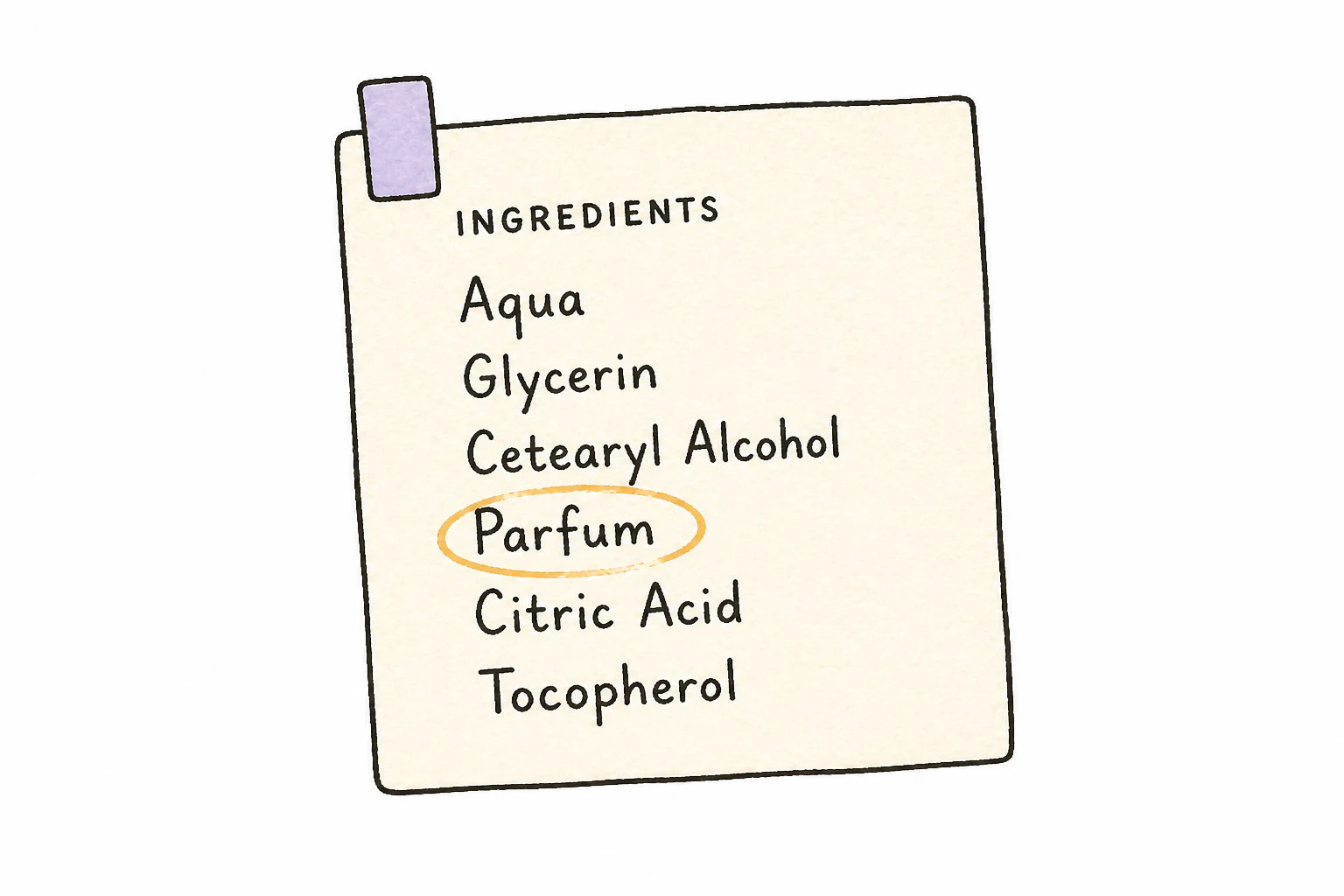
“Fragrance-free” usually means no ingredients were added to give a product a scent, but the term has no single legal definition in most markets, and it is not the same as “unscented”, which often means a masking scent covers the base smell. The ingredient list is more reliable than the front of the pack: check it, and patch-test when appropriate.Scenday’s rule: trust the ingredient list over the front of the pack.
Card 08 · one of 11 in the guides catalogue
What “fragrance-free” means
Fragrance-free usually means no added scent for fragrance purposes: nothing in the formula exists to make the product smell nice. That is a useful promise, but it is a manufacturer’s promise, not a regulated one: in most markets the term has no single legal definition, so two brands can apply it differently and both be within the rules. The claim on the front of a pack is a starting point; the ingredient list on the back is the evidence.
Sensitive-skin and allergy-conscious shoppers care about this because fragrance ingredients are among the more common triggers for skin reactions, and removing them removes one variable. But “fragrance-free” narrows the field; it does not end the reading. Ingredient lists and local rules still matter.
Three terms that sound alike, and aren’t
Labels borrow each other’s credibility, and fragrance-free lends the most. Here is how the three most common claims typically differ, with the emphasis on typically:
| The label | What it usually means | The catch |
|---|---|---|
| Fragrance-free | No ingredients added to scent the product. | Not legally defined in most markets; scent-active ingredients can still be present for other purposes. |
| Unscented | The product has no noticeable smell. | Often achieved with a masking scent, so fragrance ingredients may still be in the formula. |
| Hypoallergenic | Marketed as less likely to cause reactions. | Largely a marketing term with no standard test behind it; it is not a guarantee for your skin. |
Reading the label like it matters
On an ingredient list, added scent usually appears as a single word (“parfum”, “fragrance”, or “aroma”) standing in for a blend that is rarely itemised in full. Some markets additionally require certain recognised fragrance allergens to be named individually, which is why long chemical names sometimes trail the parfum line. Botanical extracts and essential oils are worth the same attention: “natural” is not the same as “scent-free”, and plant materials can be just as scent-active as synthetics.
Two packs, one nose, two different truths
Smells of nothing. Watch how. A base smell rises; a masking scent covers it. The back tells the truth: parfum, working as a masking scent.
The fragrance-free pack makes the opposite trade. It may smell faintly (of its own ingredients) yet the back shows nothing added to scent it. Usually the stronger promise, and still worth reading.
The nose fails in both directions. No smell can hide fragrance; a faint smell can be innocent. The backs settle both, so the fronts dim, and the lists hold the stage.
Shopping more carefully
Four habits cover most of the ground: read the ingredient list, not just the front panel; patch-test when appropriate, a small area of skin for a day or two before regular use; treat marketing claims as starting points rather than guarantees; and if a product keeps causing trouble, stop using it and keep the packaging: the ingredient list is exactly what a clinician doing patch testing will want to see. Check ingredient disclosures, and for sensitive skin or known fragrance allergies, seek medical advice for serious reactions.
Questions people ask
What does “fragrance-free” actually mean?
Usually that no ingredients were added to scent the product. The term has no single legal definition in most markets, though, so brands apply it differently; the ingredient list is the more reliable check.
Is “unscented” the same as “fragrance-free”?
Usually not. “Unscented” often means the product’s base smell has been covered with a masking scent, so a product can be unscented and still contain fragrance ingredients. Sensitive-skin shoppers generally look for “fragrance-free” and then verify the ingredient list.
Can a fragrance-free product still contain fragrance chemicals?
Sometimes. Ingredients added for other purposes (preservatives, botanical extracts, essential oils) can be scent-active even when nothing was added “as fragrance”. Reading the full ingredient list matters more than the front-of-pack claim.
Is fragrance-free better for sensitive skin?
Often, but not automatically. Fragrance ingredients are a common trigger for contact reactions, so removing them removes one variable, but other ingredients can also irritate. Patch-test new products when appropriate, and discuss persistent reactions with a medical professional.
Sources & further reading
- FDA on fragrances in cosmetics: labeling and “fragrance-free” claims
- DermNet on fragrance allergy: causes, symptoms, and patch testing
- NHS on contact dermatitis: symptoms, causes and patch testing
- American Academy of Dermatology: why dermatologists ask for fragrance-free rather than unscented, which can still carry masking fragrance
How this lesson was made
- Written and edited by the Scenday Editorial Desk.
- Founder-reviewed on .
- 4 primary sources cited (see Sources & further reading above).
- Changes to this lesson are recorded in our Corrections & updates log.