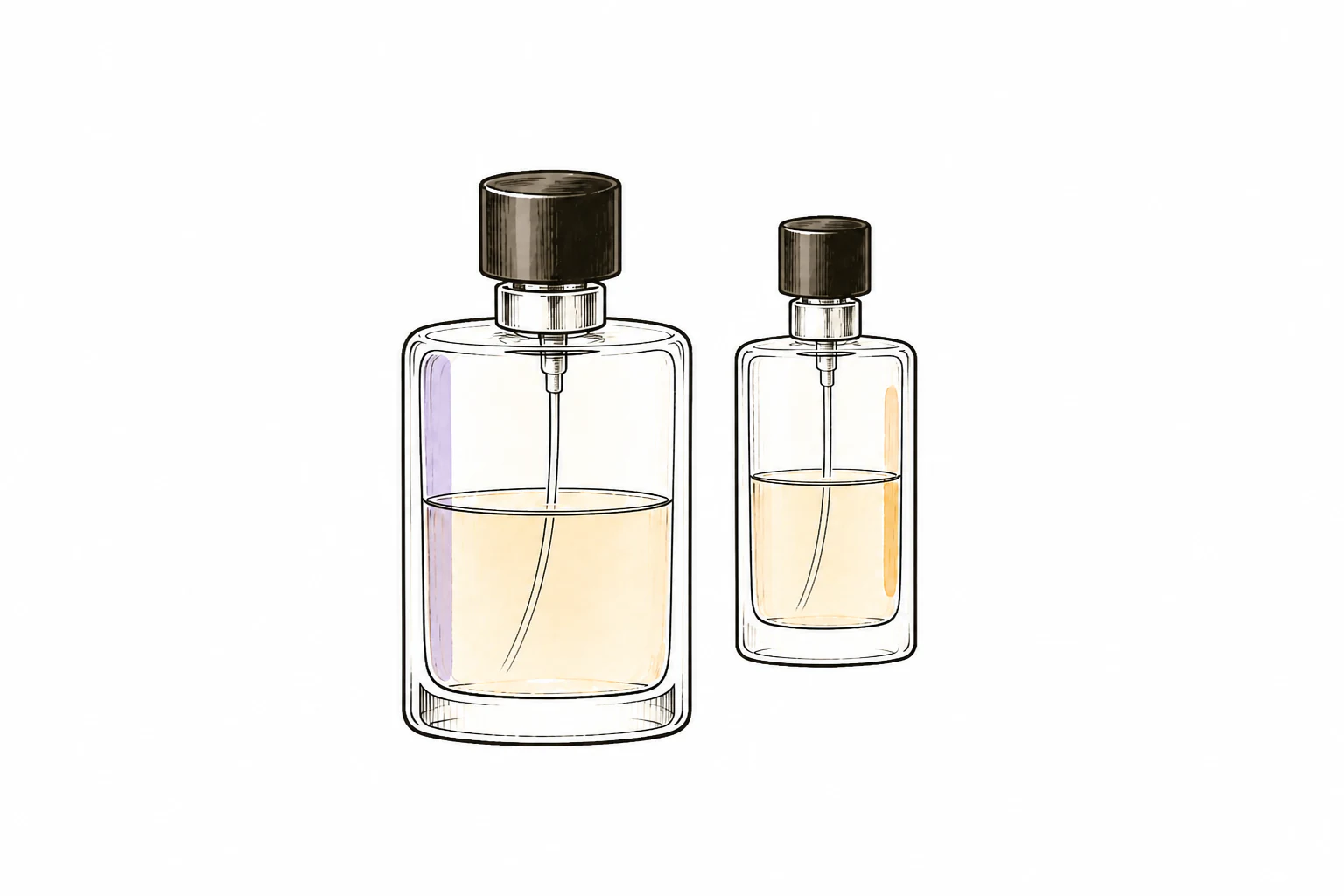
Start with one heavier anchor scent, add one lighter accent, apply the heavier scent first, and wear the pairing at home for a few hours before committing to it. Keep total sprays modest: layering is about direction, not volume.Scenday’s rule: anchor first, accent second, one pairing at a time.
Card 07 · one of 11 in the guides catalogue
What layering actually is
Fragrance layering is wearing two or more scents together so the result feels intentional rather than accidental. The goal is not more fragrance; it is a more personal direction than either bottle gives you alone. If you want the thinking behind the practice (how notes, families, and wear context decide which pairings make sense), read the fragrance layering guide first. This lesson is the practice: the order of operations on skin.
Everything below assumes you are layering two fine fragrances. The same logic applies to layering a perfume over a scented body product, which is in fact the gentler place to start.
Step 1 of 5
Choose your anchor scent
Pick one fragrance to set the base direction: the scent you want still present at hour four. Heavier compositions anchor best: woods, ambers, musks, vanilla, and resins all have prominent base notes that give the pairing something to stand on. If you are unsure which of your bottles qualifies, the one that lasts longest on your skin is usually the answer.
Step 2 of 5
Pick one lighter accent
Add a single lighter scent for lift: citrus, airy florals, green notes, or clean musks. One accent only while you are learning; every additional scent multiplies the ways a pairing can clash. The fragrance families guide is the map here: neighbouring families usually blend, while two loud statement scents from opposite corners usually fight.
One anchor below, one accent above: the whole method in one picture
The anchor’s plume. Sprayed on skin, it settles wide and low: dense at the core, haze at the edge. This is what “still here at hour four” looks like in the air.
The accent’s jet. One spray beside it: narrow, bright, jumping higher, sparking at the crest. The first hour belongs to this.
One silhouette. Trace the two together: low and wide, with one bright peak. That shape is the pairing, and the whole method.
Step 3 of 5
Apply the heavier scent first
Order matters. The heavier scent goes on first so the lighter one can sit above it instead of being buried underneath it. Give the anchor thirty seconds to settle before the accent: you are layering scents, not mixing liquids on your skin. Keep the count modest: two to three sprays of anchor, one to two of accent is plenty.
Anchor first, thirty seconds, accent second
The wrong way. The bright jet goes on first and earns its sparkles, then the anchor lands straight on top. Watch the sparkles go out.
The evidence stays. The failure dims but keeps its ✕, and a divider draws. Same two scents, other order.
The right way. Anchor down and settled, thirty seconds on the ring, accent second: the jet keeps its sparkles. That finished picture is Plate I.
Step 4 of 5
Place the two scents thoughtfully
Where you spray decides how much the two scents merge. Fabric holds scent longer than skin but can stain, and it locks the pairing in place; skin lets it evolve with your own skin chemistry. Scroll through the placement decision below.
Where it lands decides what it becomes
On fabric. The pairing sets like a photograph: stitched in place, still faint tonight. But it cannot change, and the cuff pays in stains.
On skin. The same pairing breathes: dome and flame trading fullness, drift rising, your chemistry joining in.
The trade. Fabric preserves; skin lives. Neither is wrong. The plate just makes you choose it on purpose.
Step 5 of 5
Test on skin, then wait for the dry-down
The first ten minutes tell you almost nothing: that is two openings talking over each other. The dry-down decides whether a pairing works, so wear it at home for three to four hours before committing to it for a full day out. One pairing at a time, and note what worked: which anchor, which accent, how many sprays, where.
This is the habit the whole method rests on, the same sample-first thinking Scenday applies to buying: test small, on skin, before you commit.
The layering calculator is in development: it will check a pairing against note and family logic before you spray. Get early access and we will tell you the day it opens.
What the calculator will check →Pairings that work for beginners
These four directions are forgiving: each pairs a well-anchored family with an accent that lifts rather than competes.
| Anchor | Accent | What you get |
|---|---|---|
| Vanilla / amber | Citrus | Brighter warmth: the sweetness stays, the heaviness lifts. |
| Woods | Clean musk | A quiet, polished skin scent for offices and close quarters. |
| Amber | Rose | Classic depth: florals read richer over resinous warmth. |
| Musk | Green / fresh | Laundry-clean lift with more staying power than fresh alone. |
Three mistakes that ruin most first attempts
Too many scents at once. Three fragrances is a negotiation; two is a conversation. Master pairs before trios.
Layering two statement scents. Two loud, complex compositions fight for the same air. One leads, one supports.
Judging in the first ten minutes. Openings clash by nature. Wait for the dry-down before you call a pairing a failure.
Questions people ask
Can you layer two perfumes?
Yes: wearing two fragrances together is exactly what layering means. Start with one heavier anchor and one lighter accent, and keep total sprays modest. Layer fragrances you already wear happily on their own before pairing anything unfamiliar.
What goes first when layering perfume?
The heavier, stronger scent goes on first. Applying the lighter scent second lets it lift the pairing instead of being buried.
How many sprays should I use when layering?
Fewer than you think: two to three sprays of the anchor and one to two of the accent is plenty. Layering is about direction, not volume.
Does layering make perfume last longer?
It can. Anchoring a short-lived scent over a base-heavy one often extends how long the overall impression lasts on skin, though results vary with skin chemistry.
A note on skin safety
Sources & further reading
- IFRA, the International Fragrance Association: fragrance safety standards
- NHS on contact dermatitis: symptoms, causes and patch testing
- DermNet on fragrance allergy: causes, symptoms, and patch testing
- The Perfume Society: fragrance education library
- British Association of Dermatologists: patch testing, the clinical procedure that identifies a contact allergy
How this lesson was made
- Written and edited by the Scenday Editorial Desk.
- Founder-reviewed on .
- 5 primary sources cited (see Sources & further reading above).
- Changes to this lesson are recorded in our Corrections & updates log.