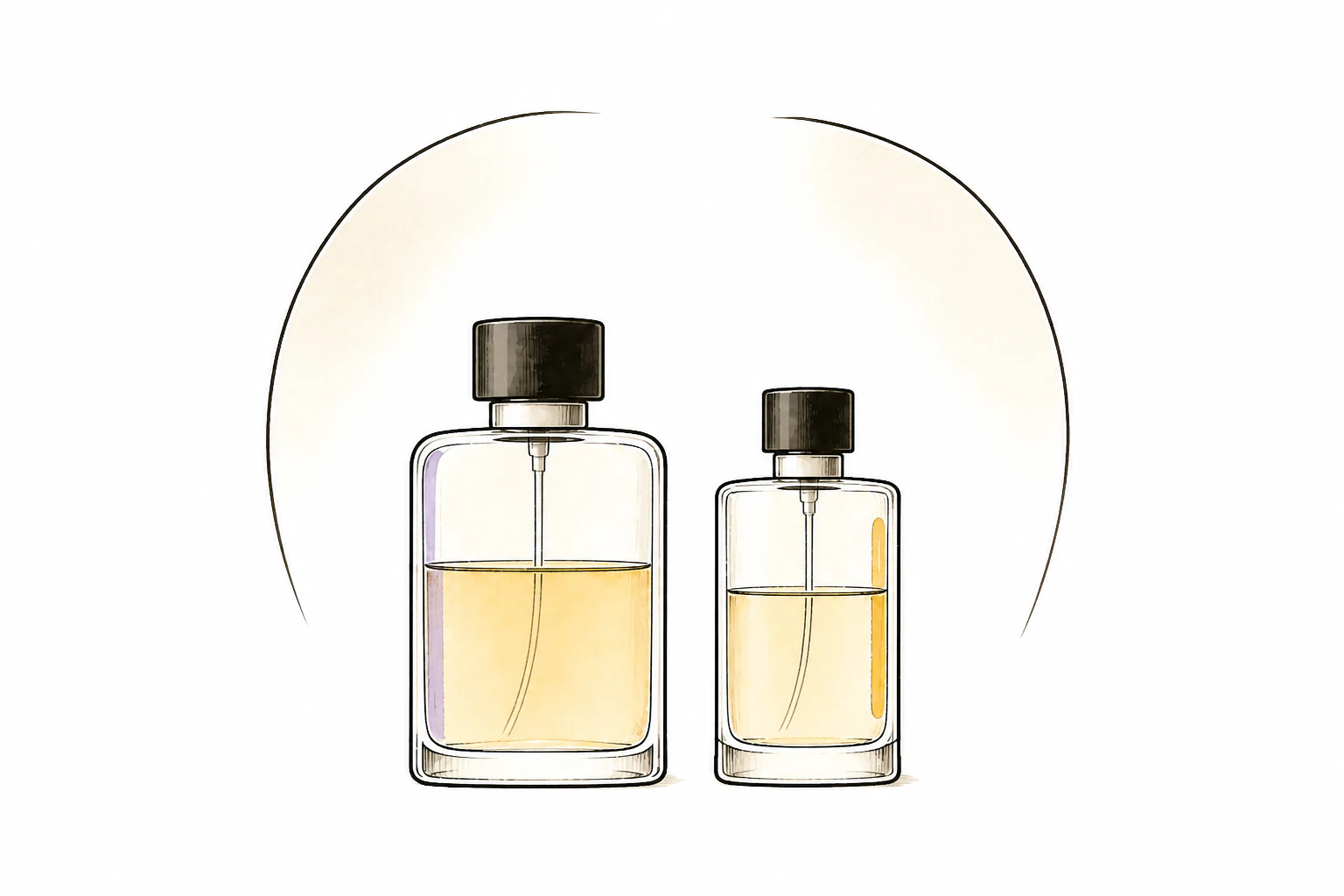
Fragrance layering is wearing two or more scents together so they read as one intentional composition. It works when three things line up: the notes interleave (one scent’s base under another’s top), the families are compatible, and the strengths are balanced so neither buries the other.Scenday’s rule: pair by notes and families first, then balance strength.
Card 06 · one of 11 in the guides catalogue
What layering is, and what it isn’t
Fragrance layering is the practice of wearing two or more scented products at once (two perfumes, or a perfume over a scented lotion or oil) so the combination feels chosen rather than accidental. The key word is wearing: layering happens on your skin, one application over another, and is reversible tomorrow. It is not the same as mixing: combining liquids in a bottle is permanent chemistry, and can spoil both fragrances.
It is also not about volume. A layered pairing should occupy roughly the same space as one generously applied perfume; what changes is the direction. Two scents wear as a single new impression because their materials evaporate together, interleave, and reach your nose as one accord.
Why people layer
Four honest reasons, in rising order of ambition:
Any two bottles can be combined in a way nobody else happens to wear. The pairing is yours in a way no bestseller can be.
A citrus accent turns a winter amber into a summer scent. Layering multiplies contexts without multiplying bottles.
Many people’s signature scent is not a perfume; it is a layering pattern they return to until it becomes recognisably theirs.
Too sweet, too loud, too flat: the bottle you nearly love can often be steered by the right partner instead of abandoned.
Lever one: notes (two pyramids, interleaved)
Every fragrance is built as a pyramid of notes that evaporate at different speeds: bright tops first, lasting base notes last (the perfume notes guide covers this properly). Layering works by interleaving two pyramids: your accent’s lively top rides over your anchor’s enduring base, and the two hearts meet in the middle. That is also why a pairing keeps changing on skin: the layers thin out at different hours, so the blend at hour three is not the blend at minute five.
Two pyramids pour into the bottle you actually wear.
The accent lends its opening. Its bright top pours in first: the first thing anyone smells off a layered pairing is the lighter scent.
The hearts meet; the anchor holds the floor. Both middles blend into one shared heart, the anchor’s base pours in last: thick, slow, and still there at hour six.
Lever two: families (neighbours blend, contrast needs a leader)
Fragrance families sit on a wheel, and position predicts risk. Neighbouring families share materials (amber next to woods, citrus next to green), so adjacent pairings blend almost effortlessly. Distant families are high-contrast: they can produce the most interesting pairings you will ever wear, but only when one scent clearly leads and the other clearly supports. The naive rule “opposites clash” is wrong; the true rule is contrast needs a leader. Spin the wheel below, then explore the full map in the fragrance wheel tool.
Spin the wheel: where it lands decides the risk.
Adjacent, amber next to woody: shared warm materials, nothing competes. The chord is short and thick: the low-risk pairing every beginner should start with.
Across the wheel, amber to citrus: the chord crosses the whole map. Brilliant when one clearly leads (the crown sits on the anchor) and a mess when both shout.
Lever three: strength (balance, not volume)
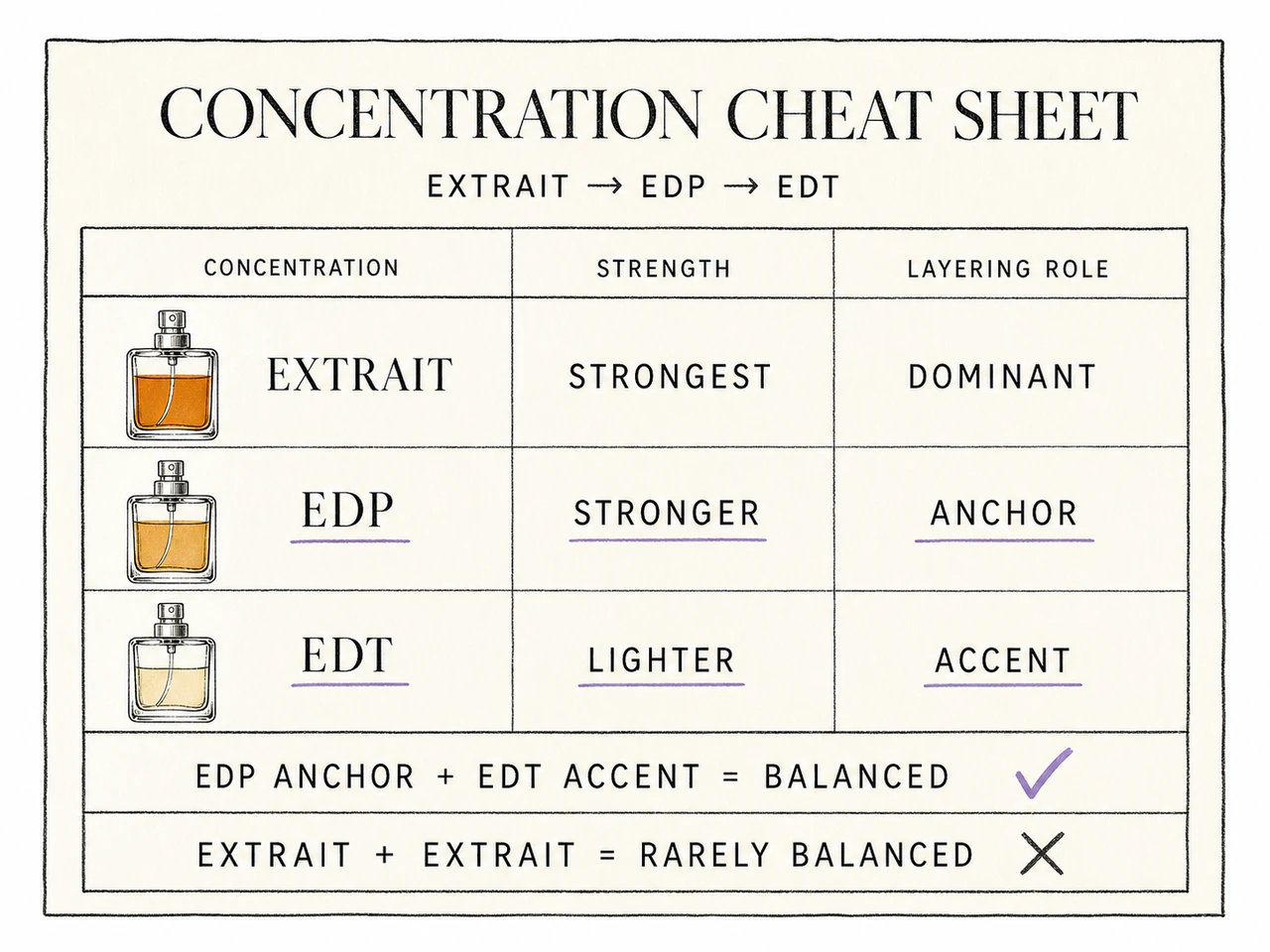
The last lever is the one most beginners miss. Two fragrances at full projection do not blend; they hold a shouting match. A pairing needs hierarchy: a stronger, longer-lasting anchor and a lighter accent that decorates it. Concentration is the cheat sheet: an eau de parfum anchor under an eau de toilette accent cooperates almost by default, while extrait over extrait almost never does. (The other throttle is how much you spray, and that belongs to the practical.)
When not to layer
When the composition is already complete. Great perfumes are finished arguments; some need no reply. If you reach for a bottle precisely because it is perfect, wear it alone.
In close, unavoidable company. Interviews, flights, hospitals: experiments belong at home, not in rooms people cannot leave.
When your skin is already unhappy. More product means more exposure. Irritated or broken skin is a reason to pause, not to test a new pairing.
The layering calculator is in development: it will check two scents against note and family logic before you spray. Get early access and we will tell you the day it opens.
What the calculator will check →Questions people ask
What is fragrance layering?
Fragrance layering (also called perfume layering or scent layering) is wearing two or more scents together (on skin or over scented body products) so they read as one intentional composition rather than an accident.
Does fragrance layering actually work?
Yes, when the pairing respects three things: interleaved notes, compatible families, and balanced strengths. It fails most often when two dominant scents compete to lead.
Which fragrance families layer well together?
Neighbouring families blend most easily: amber with woods, citrus with green. High-contrast pairs from across the wheel can work brilliantly when the lighter scent is clearly the accent.
Is layering the same as mixing perfumes?
No. Layering happens on your skin and is reversible tomorrow; mixing combines liquids in a bottle permanently, and can spoil both fragrances.
A note on skin safety
Sources & further reading
- Fragrances of the World: Michael Edwards’ fragrance wheel and family taxonomy
- IFRA, the International Fragrance Association: fragrance safety standards
- NHS on contact dermatitis: symptoms, causes and patch testing
- The Perfume Society: fragrance education library
- International Journal of Cosmetic Science: skin hydration, pH and temperature measurably change how fast a fragrance evaporates
How this lesson was made
- Written and edited by the Scenday Editorial Desk.
- Founder-reviewed on .
- 5 primary sources cited (see Sources & further reading above).
- Changes to this lesson are recorded in our Corrections & updates log.