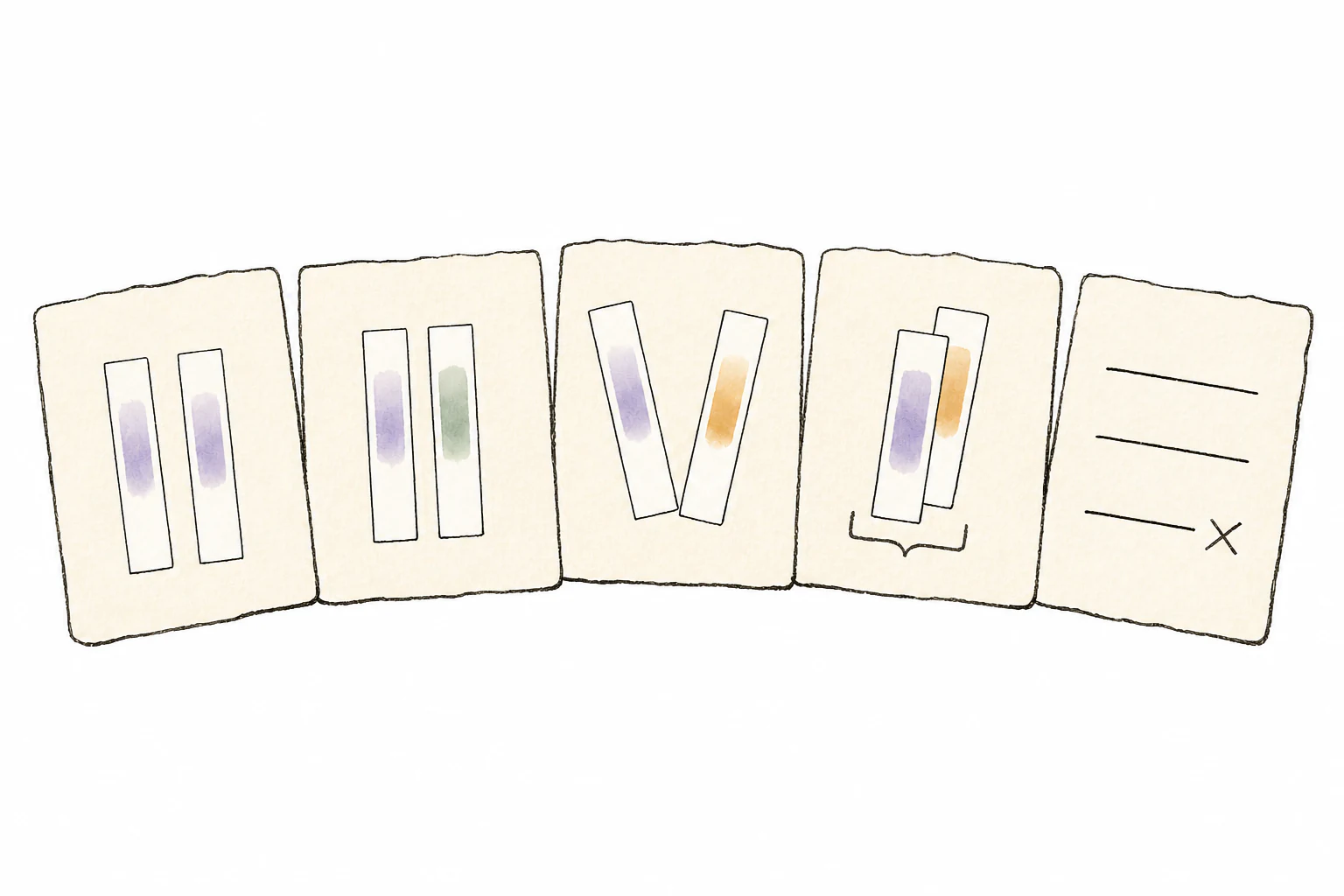
Test on skin, not just paper. Give each fragrance a full wear, in your real weather, before judging it. Then follow a five-step order: familiar families, one adjacent family, two contrasts, one layering pair, and an avoid list. A blind buy is what this method replaces.Scenday’s method: skin, full wears, real weather, and notes you can decide from.
Card 11 · one of 11 in the guides catalogue
Why a method
Most sampling fails the same way: ten paper strips in a shop, a fast favourite, and a bottle that feels wrong within a week. The failure is not taste; it is procedure. Strips shortlist, but only skin can decide, because your skin chemistry bends every composition, and only a full wear shows you the dry-down you will actually live with.
The method below fixes the order of testing, not your taste. Five steps, a handful of vials, one wear at a time, in your real weather and your real clothes. If skin ever reacts along the way, the perfume allergy guide covers patch testing and when a reaction deserves a doctor.
Step 1 of 5
Start with your familiar families
Sample two or three fragrances from families you already wear well. They calibrate your nose and give every later test a baseline. Two or three families you already wear give every later test a baseline: you know how a good fit behaves on your skin, so a bad fit has nowhere to hide.
Step 2 of 5
Test one adjacent family
Pick one family that borders your comfort zone: woods wearers try a chypre, fresh wearers try an aromatic. Adjacent is where taste grows without gambling. The fragrance families guide maps which families border yours; one adjacent sample per round is enough.
Step 3 of 5
Sample two deliberate contrasts
Add two wildcards from families you assume you dislike. Most people’s map of their own taste has at least one wrong border, and a 2ml vial is the cheapest way to find it. Contrasts are where a scent profile earns its keep: the surprises they turn up are exactly what no bestseller chart could have predicted for you.
Step 4 of 5
Try one layering pair
Once two favourites emerge, wear them together once. Some samples earn a bottle; others earn a place as an accent over something you own. Keep the pairing simple: one anchor, one accent. The layering guide explains what anchors and what lifts before you spend a wear on the experiment.
Step 5 of 5
Keep an avoid list
Write down what failed and why: too sweet, too loud, gone by noon. An avoid list turns every failed sample into money saved on the next one. Note the practical facts too: how many sprays you used, the weather that day, and the longevity you actually got. Three lines per wear is plenty; the pattern across ten wears is the real product.
Common mistakes
Sniffing ten strips and calling it testing. Strips shortlist; they cannot decide. Nothing replaces hours on your own skin.
Judging the opening only. The first ten minutes are the loudest and least representative part of a wear. Wait for the dry-down.
Testing outside your real life. A fragrance auditioning for the office should be tested on a work day, in work clothes, in your actual weather.
The 60-second quiz is in development: it will sketch your scent profile so step one starts from families you actually wear, not a guess. Get early access and we will tell you the day it opens.
What the quiz will do →Questions people ask
How long should you test a perfume before buying it?
At least one full wear: morning to evening, on skin. Two or three wears across different weather is better; a fragrance that survives repetition has earned a bottle.
Should you test perfume on skin or paper?
Paper strips are for first impressions and quick eliminations. A buying decision needs skin: your warmth, oils, and dryness change how a composition behaves over hours.
How many perfumes can you test at once?
Two on skin at most, one per wrist or forearm, or the trails cross. Use paper strips to shortlist a counter full of options, then give skin to the finalists.
What is a blind buy?
Buying a full bottle without ever smelling the fragrance. Sometimes it works out; more often it is the most expensive way to learn that reviews describe someone else’s skin.
Sources & further reading
- Highsnobiety: the state of fragrance, test-first behaviour
- IFRA, the International Fragrance Association: fragrance safety standards
- The Perfume Society: fragrance education library
- Hong Kong Baptist University Department of Chemistry: heat from skin drives the evaporation that decides how long a wear lasts
How this lesson was made
- Written and edited by the Scenday Editorial Desk.
- Founder-reviewed on .
- 4 primary sources cited (see Sources & further reading above).
- Changes to this lesson are recorded in our Corrections & updates log.